

Searching for Lebanese food near you usually means one thing: you want fresh mezze, smoky grilled meats, and warm pita — and you want to know where to find the real thing and what to order when you get there. The quickest way to find a good Lebanese restaurant is to search “Lebanese restaurant” in Google Maps, filter by a rating of 4.3 or higher with at least a few hundred reviews, and look for signs of authenticity: a shawarma spit turning behind the counter, pita baked in-house, and a mezze menu that goes beyond hummus. If you are ordering for the first time, start with hummus, tabbouleh, and falafel, then a shish taouk or mixed grill — that combination shows you what Lebanese cooking does best.

Lebanese Food at a Glance
| What to know | The short version |
|---|---|
| Best first order | Hummus, tabbouleh, falafel, then shish taouk or a mixed grill |
| Signature style | Mezze — many small shared plates, eaten with pita, before or instead of a main course |
| Core flavours | Garlic, lemon, olive oil, sumac, za’atar, tahini, pomegranate molasses |
| Good for | Sharing, vegetarians and vegans (many mezze dishes are plant-based), halal diners (most Lebanese restaurants serve halal meat — ask to confirm) |
| Watch out for | Sesame (tahini is in hummus, baba ghanoush, and falafel sauce), nuts (muhammara, baklava), gluten (pita, bulgur, kibbeh) |
| Typical format | Casual counter-service spots for shawarma and wraps; sit-down restaurants for a full mezze spread |
| UNESCO recognition | The Mediterranean diet, which Lebanese cooking exemplifies, was inscribed on UNESCO’s Representative List of the Intangible Cultural Heritage of Humanity in 2010 and extended in 2013 |
How to Find Good Lebanese Food Near You
“Near me” searches work best when you know what separates a great Lebanese restaurant from a generic one. Use these steps:
- Search Google Maps for “Lebanese restaurant” or “Lebanese food”. Maps results are ranked by distance, rating, and relevance, so this is the most reliable starting point. Check the photos, not just the stars: look for a vertical shawarma spit, fresh-baked pita, and colourful mezze spreads.
- Read the recent reviews for specifics. The most useful reviews name dishes — “the toum is properly garlicky”, “the tabbouleh is mostly parsley” — rather than just saying “great food”. A Lebanese reviewer praising the food is a strong signal.
- Check the menu before you go. A serious Lebanese restaurant lists a full mezze section (cold and hot), several grills, and at least one or two desserts such as baklava or knafeh. A menu with only shawarma wraps and generic “Mediterranean” salads is usually a fast-food spot, which can still be good, but it is not the full experience.
- Look for halal certification if it matters to you. Most Lebanese restaurants serve halal meat, but not all do — check the menu or website, or call ahead.
- Try delivery apps as a discovery tool. Searching “Lebanese” on a delivery app shows you every Lebanese kitchen in range, including small spots with no dine-in area. Sort by rating and read the dish-level reviews.
- Ask your local community. Lebanese bakeries, Middle Eastern grocery stores, and community groups are often the best source for the family-run spot that does not advertise. If your town has a Lebanese bakery selling manakish (za’atar flatbread), you are already close to good food.
If you are new to “near me” searching in general, our guide to finding stores near you covers the same map and search techniques for any kind of local business.
What Is Lebanese Food?
Lebanese cuisine is one of the oldest food traditions in the world, rooted in the Levant — the eastern Mediterranean region spanning modern Lebanon, Syria, Palestine, and Jordan. Its history is layered: Phoenician traders, Persian, Greek, Roman, Arab, and Ottoman influences all folded into a tradition built on olive oil, grains, legumes, vegetables, herbs, and grilled meat. The word mezze itself carries that history — it comes from the Persian maza (taste, relish), was absorbed into Turkish as meze, and entered Levantine Arabic through centuries of Ottoman rule.
The cuisine’s philosophy is abundance through variety: many small preparations, each precise, served together. Olive oil, garlic, and lemon are the core ingredients of nearly every dish, and baharat — a warm seven-spice blend — seasons the grills. Lebanon’s national dish is kibbeh, made with ground lamb, bulgur, and spices, sometimes served raw as kibbeh nayyeh.
Lebanese cooking is also one of the healthiest food traditions in the world. It is a classic expression of the Mediterranean diet, which UNESCO inscribed on its Representative List of the Intangible Cultural Heritage of Humanity in 2010, recognising it as a set of skills, rituals, and traditions handed from generation to generation, with the inscription extended to seven countries in 2013. The science backs up the reputation: the landmark PREDIMED trial in Spain, following thousands of adults at high cardiovascular risk, found that participants assigned to a Mediterranean diet experienced roughly 30 percent fewer major cardiovascular events than a control group, with the study’s main findings holding after it was republished with corrections in 2018. The tradition goes back further than modern nutrition science — American physiologist Ancel Keys’s Seven Countries Study, launched in the late 1950s, first linked traditional Mediterranean eating patterns with lower rates of heart disease.
What to Order: The Mezze Table
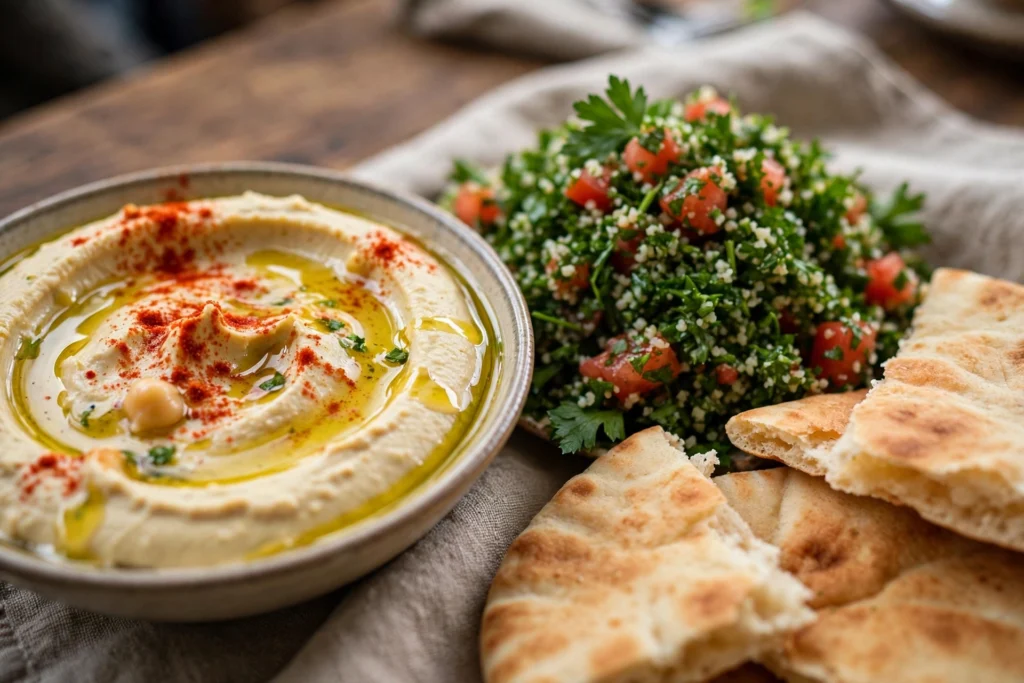
Mezze is not a starter course. In Lebanese practice, mezze is the meal itself: a spread of small plates placed at the centre of the table for everyone to share, with pita torn and used as a scoop. Order like a table, not like a person — three or four cold mezze, one or two hot mezze, and a grill to share.
Cold mezze
| Dish | What it is |
|---|---|
| Hummus | Chickpeas blended with tahini, lemon, and garlic; the earliest written reference to hummus appears in a 13th-century Arabic cookbook from Aleppo |
| Baba ghanoush / mutabal | Smoky roasted eggplant; mutabal is mixed with tahini, and some menus use the two names for the same dish |
| Tabbouleh | Mostly parsley, with tomato, mint, onion, a little bulgur, lemon, and olive oil — a good tabbouleh is green, not brown |
| Fattoush | Chopped salad with toasted or fried pita pieces and a sumac dressing |
| Labneh | Thick strained yoghurt with olive oil, often with za’atar or mint |
| Muhammara | Roasted red pepper and walnut dip with pomegranate molasses (contains nuts) |
| Warak enab | Stuffed grape leaves, usually filled with rice, herbs, and sometimes meat |
Hot mezze
- Falafel — fried balls of ground chickpeas or fava beans with herbs, served with tahini sauce. Crisp outside, green and fluffy inside.
- Kibbeh — a shell of bulgur and ground meat, stuffed with more spiced meat and pine nuts, then fried. The national dish, and the one to judge a kitchen by.
- Sambousek — small pastries filled with meat or cheese.
- Halloumi — a firm cheese grilled or fried until golden.
- Batata harra — cubed potatoes fried with garlic, coriander, and chilli.
- Fatayer — baked triangles of dough filled with spinach, cheese, or meat.
Grills and Mains
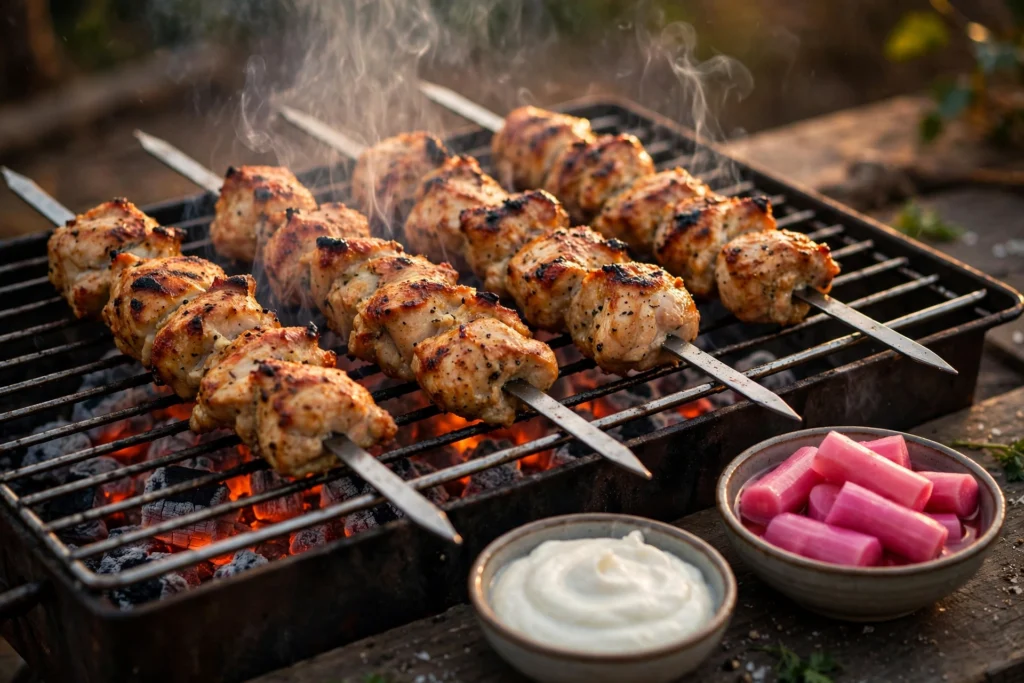
- Shish taouk — chicken marinated in garlic, lemon, and yoghurt, grilled on skewers. Usually served with toum, the whipped garlic sauce. This is the single best first main course for a newcomer.
- Kafta — minced beef or lamb with onion and parsley, shaped onto skewers and grilled.
- Lahm meshwi — cubed lamb or beef skewers.
- Shawarma — meat stacked on a vertical spit and shaved thin. Chicken shawarma is usually served with garlic sauce and pickles in a wrap or as a plate with rice. The spit should be visibly turning and freshly carved — pre-sliced shawarma sitting in a tray is a warning sign.
- Mixed grill — a platter of several grills with rice or fries and grilled vegetables. The best choice for a group that cannot decide.
Sauces on the Table
Two sauces appear with almost everything. Toum is a whipped garlic sauce, white, fluffy, and very strong — it goes on shawarma, shish taouk, and fries. Tahini sauce (tarator) is sesame paste thinned with lemon juice and water; it accompanies falafel, fish, and vegetables. If you have a sesame allergy, ask before ordering hummus, baba ghanoush, or falafel sauce, because tahini is in all of them.
What to Order for Different Situations
- First visit, two people: hummus, tabbouleh, falafel, and a shish taouk or mixed grill to share, with pita. Add baklava to finish.
- Solo lunch: a chicken shawarma wrap with garlic sauce and pickles, or a falafel wrap — the easy single order.
- Vegetarian or vegan: a mezze-only meal is one of the best vegetarian meals in any cuisine — hummus, baba ghanoush, tabbouleh, fattoush, falafel, and batata harra are all plant-based. Ask about labneh and halloumi if you eat dairy, and confirm the falafel is fried separately if that matters to you.
- Feeding a group: order a full mezze spread plus a mixed grill platter. Lebanese restaurants are built for sharing, and ordering this way is usually better value than individual mains.
- With kids: shish taouk skewers, hummus with pita, and fries are reliable. Lebanese food is seasoned rather than spicy — garlic, lemon, herbs, and sumac rather than chilli heat — so most dishes suit children.
Desserts and Drinks
Save room for dessert. Baklava is layered filo pastry with nuts and syrup; knafeh is warm cheese under shredded or semolina pastry, soaked in syrup; and ashta desserts use a thick clotted cream, often with honey and pistachio. Fresh fruit — melon, oranges, grapes, and figs — is also a traditional way to finish a Lebanese meal. To drink, look for Lebanese lemonade with mint, ayran (a salted yoghurt drink), or Arabic coffee, served small, strong, and often flavoured with cardamom.
Is Lebanese Food Healthy?
Lebanese food is one of the healthiest cuisines you can order, because its foundations are vegetables, legumes, whole grains, olive oil, herbs, and lean grilled protein. A mezze-based meal is naturally high in fibre and plant diversity and low in processed food. That said, not everything on the menu is light: fried kibbeh and falafel, white pita in large quantities, and syrup-soaked desserts add up. The healthiest way to eat Lebanese is the traditional way — mezze-led, with grilled rather than fried mains, and fruit or a small sweet to finish.
For the wider cultural context, UNESCO’s page on the Mediterranean diet describes the shared traditions behind Lebanese cooking, and a good overview of Lebanon’s food and culture is available from International Cuisine.
What Does Lebanese Food Cost?
Prices vary widely by city, neighbourhood, and format, so treat any single figure with suspicion. As a general guide, a shawarma or falafel wrap from a counter-service spot is usually one of the cheapest filling lunches in any city, while a full sit-down mezze spread for a group costs more but is shared across the table, which brings the per-person price down. Mezze plates are typically priced individually, so a table of four sharing six mezze and a grill often eats very well for less than four separate mains elsewhere. Check the menu online before you go — most Lebanese restaurants publish one — and note that delivery apps usually charge more than ordering direct or dining in.
How to Spot an Authentic Lebanese Restaurant
- The shawarma spit is turning and carved to order, not pre-sliced.
- Pita is warm and fresh, ideally baked in-house or delivered daily from a Lebanese bakery.
- Tabbouleh is mostly parsley. If it looks like a bulgur salad with a little green, the kitchen is cutting corners.
- Toum is made in-house — fluffy, white, and powerfully garlicky, not a mild bottled garlic mayo.
- The menu has depth in mezze, including dishes such as muhammara, labneh, and warak enab, not just hummus and falafel.
- Pickled turnips are pink. The bright pink pickled turnips served with shawarma get their colour from beetroot, and they are a small but telling sign of a kitchen that does things properly.
The Bottom Line
The best Lebanese food near you is the place with a turning shawarma spit, fresh pita, a deep mezze menu, and reviews that name specific dishes. Start with hummus, tabbouleh, and falafel, add shish taouk or a mixed grill, and finish with baklava or knafeh. Order to share, eat with pita, and let the mezze table do what it has done for centuries: turn a meal into a gathering.
Frequently Asked Questions
What is the most popular Lebanese dish?
Hummus is the most famous Lebanese dish worldwide, and shawarma is the most popular single order at Lebanese restaurants. For a first visit, the classic combination is hummus, tabbouleh, and falafel followed by shish taouk (garlic-marinated grilled chicken skewers).
Is Lebanese food spicy?
Mostly no. Lebanese food is seasoned with garlic, lemon, herbs, and spices such as seven-spice (baharat) and sumac rather than chilli heat. Dishes such as batata harra do carry some chilli warmth, but most of the menu is flavourful without being hot.
Is Lebanese food healthy?
Yes — Lebanese cooking is a classic expression of the Mediterranean diet, built on vegetables, legumes, whole grains, olive oil, and lean grilled protein. The PREDIMED trial found that a Mediterranean diet was associated with roughly 30 percent fewer major cardiovascular events than a control diet. Fried items and syrupy desserts are the exceptions, so a mezze-led meal with grilled mains is the healthiest way to eat.
What is mezze?
Mezze is a spread of small hot and cold dishes served together at the centre of the table for sharing, eaten with pita bread. In Lebanese practice mezze is the meal itself, not just a starter course. A typical spread includes hummus, baba ghanoush, tabbouleh, fattoush, falafel, and kibbeh.
Is Lebanese food halal?
Most Lebanese restaurants serve halal meat, but not all do. Check the menu or website for halal certification, or call ahead to confirm before you visit.
What should I order at a Lebanese restaurant for the first time?
Order hummus, tabbouleh, and falafel to share, then shish taouk or a mixed grill as a main, with pita and toum (garlic sauce) on the side. Finish with baklava or knafeh. If you are eating alone, a chicken shawarma wrap is the easy single order.
