
You can find the owner of a property by address for free in most cases, and it usually takes under ten minutes. Property ownership is public record in every US state, and the fastest route is your county assessor’s free online property search: type in the street address and you will typically see the owner’s name, the mailing address where the tax bill goes, and the parcel number. If the assessor’s site does not show a name, confirm it against the most recent deed at the county recorder’s office — also free to view in most counties.


The Free Methods at a Glance
| Method | What you get | Cost | Speed |
|---|---|---|---|
| County assessor / property appraiser search | Current owner of record, mailing address, parcel number, assessed value | Free | Under a minute in most counties |
| County recorder / register of deeds | The recorded deed — the authoritative ownership document | Free to view online or in person in most counties | A few minutes |
| County GIS parcel map | Owner name by clicking a parcel on a map; boundaries and zoning | Free | A few minutes |
| County tax collector / treasurer | Taxpayer name and tax payment history | Free | A few minutes |
| Secretary of State business search | Registered agent and officers when the owner is an LLC or company | Free | A few minutes |
| Neighbours, permits, and public notices | Clues when records are incomplete or the owner is absentee | Free | Varies |
Why Ownership Records Are Free
In the United States, property ownership is recorded in a public register. When a property changes hands, a deed is filed with the county, and the county assessor lists the owner on the tax roll so the tax bill reaches the right person. Because these are government records, they are open to anyone — you do not need to be a resident, a buyer, or a professional to look them up.
The records are split across three different county offices, each answering a different question, and there are over 3,000 counties in the US, each running its own version of the system.
| Question | Office to ask | What it holds |
|---|---|---|
| Who owns it now? | County assessor | Owner of record, mailing address, assessed value |
| How did they get it, and what is attached? | County recorder | Deeds, mortgages, liens, judgments |
| Where exactly is the parcel, and what are its boundaries? | County GIS / mapping office | Map, parcel number, acreage, zoning |
Method 1: Search the County Assessor (the Fastest Way)
The county assessor values every parcel for property tax purposes and keeps a running database of who owns what. Nearly every county now publishes a free online search of that database.
Step by step
- Find the county. Property records are kept by county, so start by identifying which county the address sits in. If you are unsure, search the address plus the word “county” and the answer usually appears immediately.
- Find the assessor’s property search. Search for the county name plus “assessor property search” or “property information”. The office goes by different names depending on the state: assessor, property appraiser (Florida), appraisal district (Texas), auditor, or department of assessments. The tool may be branded as a property lookup, parcel search, or real estate search.
- Enter the street number and street name only. Leave the city and ZIP code empty on the first attempt. Many county systems match on a normalised address string and return nothing when extra fields are supplied. Searching “4820 NEVADA” can find a property that a full formatted address will not.
- Read the result. You will typically get the owner of record, the taxpayer mailing address, the parcel identification number (also called the APN or PIN), the assessed or estimated market value, the legal description, and often the last sale date and price.
The mailing address is the part most people miss and the part that matters most. If it differs from the property address, the owner probably does not live there — useful if you are trying to contact an absentee owner, and a strong clue that the property may be a rental or investment.
If the county’s online portal is not cooperating, or the property is in a rural jurisdiction that has not digitised older records, call the assessor’s office. Staff can look up the parcel by phone.
For a worked example of what a county property appraiser’s office does and the records it keeps, see our guide to the Palm Beach County Property Appraiser.
Two cautions about assessor data
First, assessor records are updated on the county’s own schedule, so a sale that closed last month may not appear yet. Sonoma County’s recorder notes that the assessed owner is not necessarily the legal owner, and that there is a delay between a recorded transfer and the assessor’s update. Second, the assessed value is a tax figure, not a market price — use the assessor for the name and parcel number, not for pricing the property.
Method 2: Check the Recorded Deed at the County Recorder
The assessor tells you who the county bills. The recorder tells you who holds title. The county recorder — also called the register of deeds, county clerk, or clerk of court depending on the state — files and preserves every deed, mortgage, lien, and easement tied to a property.
Search the recorder’s online index for the most recent deed into the current owner. It shows the exact way title is held (for example, “John A. Smith and Mary B. Smith, husband and wife” or “Smith Family Trust dated June 4, 2009”), the date it was recorded, and the instrument number. You can usually search by address, by the grantor or grantee name, or by the document recording number.
This step matters most when the records disagree. If a property just changed hands, the assessor’s records and the recorder’s records may temporarily name different owners. When that happens, the recorder is right: a deed recorded last week is real ownership even though the tax roll will not catch up for months.
In some counties the recorder’s online search is limited, and you may need to visit the office in person. Viewing records in person is usually free, though obtaining physical copies may carry a small processing charge.
Method 3: Use the County GIS Parcel Map
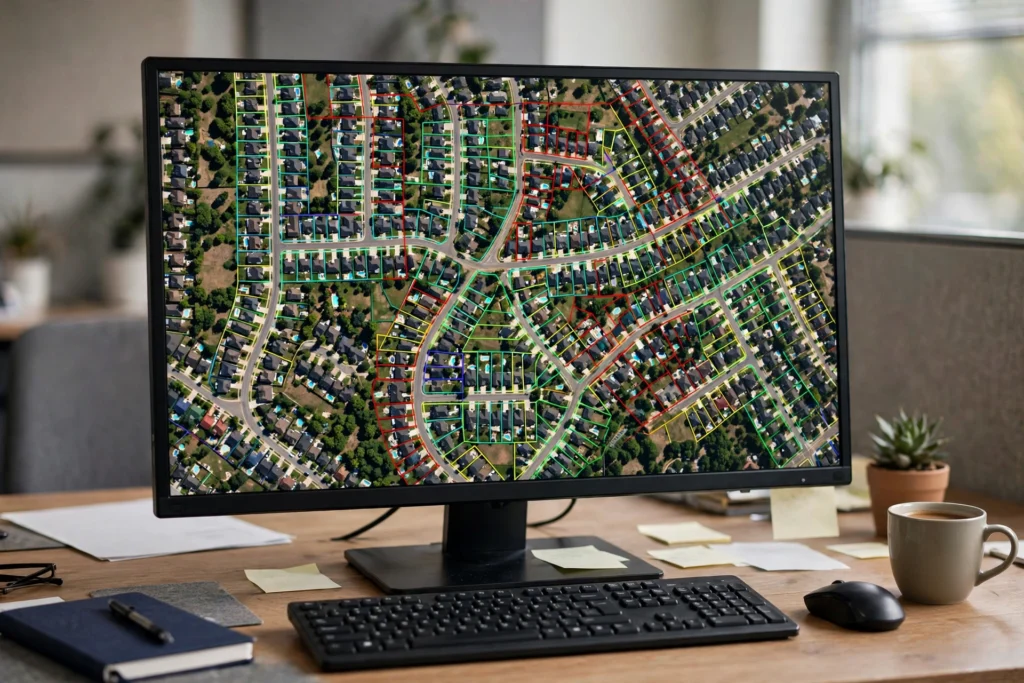
Most counties publish an interactive GIS (Geographic Information System) map that layers parcel boundaries over aerial photos. Instead of typing an address into a search bar, you navigate a map, zoom into a neighbourhood, and click directly on a parcel. A pop-up or sidebar then shows the owner name, parcel number, acreage, zoning classification, and assessed value.
GIS viewers are especially handy when you do not have an exact address. If you are looking at a vacant lot or an oddly shaped parcel, clicking on the map is far easier than guessing at addresses. The parcel number you get from the map is the key identifier for every other search — when an address search fails, the parcel number usually works.
Method 4: Check the Tax Collector’s Records
The tax collector or treasurer is often a separate office from the assessor, and its records can fill gaps. The tax collector’s site typically shows who the tax bill is addressed to and whether taxes are current or delinquent. A property with years of unpaid taxes may be heading toward a tax sale, and the mailing address on the tax record is often the most current contact address the county has for an absentee owner.
Method 5: Trace an LLC or Trust Owner
Sometimes the assessor’s record names a company or a trust rather than a person — “123 Main Street LLC” or “The Johnson Family Trust”. That is common for investment properties.
- For an LLC or corporation: search the company in the business-entity registry of the state where it was formed. Every state runs one, usually through the Secretary of State, and the National Association of Secretaries of State links to each state’s business registration office. The registry typically shows the registered agent and sometimes officers or managers. There is no reliable federal ownership database: under a FinCEN rule first issued as an interim final rule in March 2025 and made permanent by a final rule in August 2026, US-formed companies are exempt from beneficial ownership reporting under the Corporate Transparency Act, so the state registry is the record that counts.
- For a trust: the deed itself usually names the trustee, and the trustee’s name is public record. The beneficiaries of a private trust are generally not listed in public records, and you will not find them for free.
- For an estate: if the owner has died, probate court records in the county where they lived are public and will name the executor or administrator.
Method 6: When the Records Run Dry
If the online records are incomplete, outdated, or the property is in a county that has not digitised its files, these free approaches can still help:
- Ask the neighbours. Neighbours often know who owns a nearby property, especially if it has been vacant or the owner lives out of state.
- Knock on the door. If the property is occupied, a courteous conversation may reveal the owner’s name or a property manager’s contact number.
- Check building permits. Permit applications filed with the city or county usually require the owner’s name and contact details, and many municipalities publish permit records online.
- Search the address online. A search for the full address in quotation marks can surface old listings, foreclosure notices, or code enforcement actions that name the owner.
What You Cannot Find for Free — and What the Law Limits
Free public records have real limits, and it helps to know them before you start:
- Phone numbers and email addresses are not public record. The assessor’s record gives you a name and a mailing address, not a phone number. Anyone offering a free owner phone number is usually selling a data product.
- Some counties restrict owner names online. In Los Angeles County, California, for example, owner names are not shown on the assessor’s online portal; the offices cite California Government Code section 6254.21, which restricts the online publication of certain personal information. Sonoma County similarly does not publish the assessed owner’s name online, though you can view it at the county office at no charge. In Miami-Dade County, Florida, owners with exempt status under Florida law — such as law enforcement officers and judges — can ask for their names to be removed from the publicly available records.
- Recent sales take time to appear. Between a closing and the county’s update, the old owner’s name may still show. The recorded deed is the tiebreaker.
- Ownership data is not a screening report. Property owner information is public record, but a lookup you run yourself is not a consumer report: landlords and employers who screen tenants or applicants must use FCRA-compliant consumer reports from a reporting agency, with the required disclosures and adverse-action notices.
- Use the information lawfully. Legitimate uses include buying a property, resolving a boundary question, contacting an absentee owner, or reporting a code issue. Using owner information to harass, stalk, or intimidate someone is illegal, and doxxing — publishing someone’s private details to harm them — can carry serious legal consequences.
What Paid Services Add (and When You Need One)
Free records answer “who owns it?” for most properties. Paid services add convenience and depth, not a different legal answer:
- Aggregated searches that pull assessor, recorder, and tax data from many counties into one report, saving time if you are researching many properties.
- Ownership history going back decades, including prior sales and price history in one place.
- Skip tracing, which attempts to find phone numbers and email addresses — useful for investors contacting absentee owners, and the main thing you cannot get free from the county.
- Title searches by a title company, which examine deeds, court records, and other public documents to confirm clean ownership before a purchase. If you are buying, this is the professional step that protects you.
The Bottom Line
Start with the county assessor’s free online search — it names the owner in under a minute for most US properties. Confirm the name against the most recent deed at the county recorder, use the GIS parcel map when you do not have an exact address, and trace an LLC owner through the Secretary of State’s free business registry. The only things you cannot get for free are the owner’s phone number and email address; for those, a skip-tracing service or a polite letter to the mailing address on the tax record are the honest options.
Frequently Asked Questions
How can I find out who owns a property by address for free?
Search the address on your county assessor’s or property appraiser’s free online property search. It returns the owner of record, the mailing address, and the parcel number. Confirm the name against the most recent deed at the county recorder’s office, which is also free to view in most counties.
Is property ownership public record in the US?
Yes. Property ownership is public record in every US state. Deeds are filed with the county recorder and the owner is listed on the county tax roll, and both records are open to anyone, usually online and free.
What if the owner is listed as an LLC?
Search the LLC’s name in the free business-entity registry run by the Secretary of State in the state where the company was formed. The National Association of Secretaries of State links to every state’s registry. The registry typically shows the registered agent and sometimes the company’s officers or managers.
Why can’t I find the owner’s name online in some counties?
Some counties restrict owner names on their websites for privacy reasons. In Los Angeles County, California, for example, owner names are not published online under California Government Code section 6254.21. In those counties you can usually still view the name free of charge by visiting the assessor’s office in person or calling them.
How do I find the owner of a vacant or abandoned property?
Start with the county assessor’s record, which shows the owner of record and the mailing address where tax bills are sent — for a vacant property, that mailing address is often the only way to reach the owner. If taxes are delinquent, the tax collector’s records may show the property is heading for a tax sale.
Can I find a property owner’s phone number for free?
Usually not. Phone numbers and email addresses are not part of the public property record. The assessor gives you a name and a mailing address. A letter to that mailing address is the free way to make contact; skip-tracing services sell phone and email lookups, but they are paid products.
